Going to Buenos Aires for the polo? This guide covers what to book, how a day at Palermo works, and what else to do around it — plus enough about the sport and how teams qualify to follow the action like a local.
What the Argentine Open is
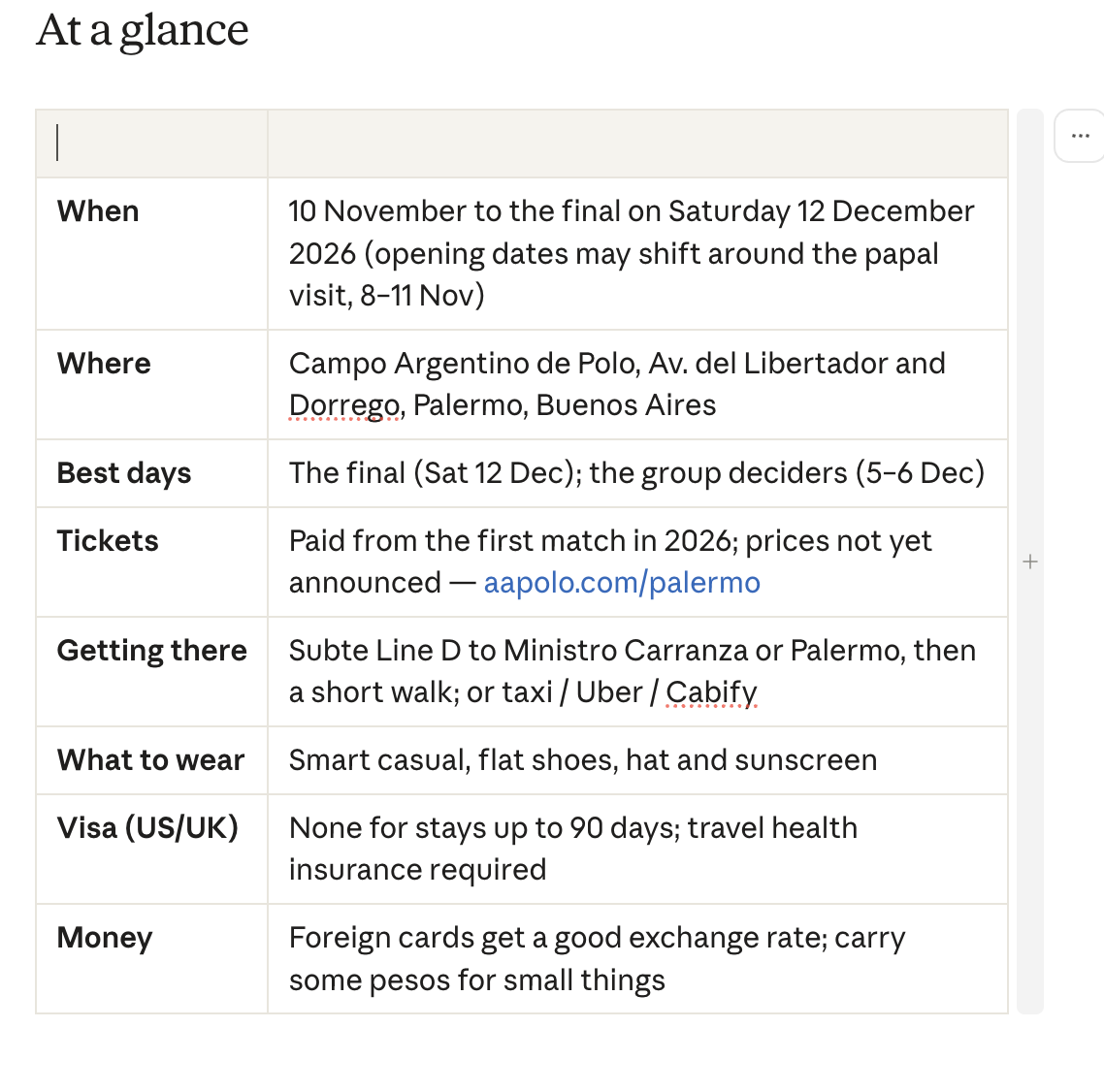
The Argentine Open is the world's most important polo tournament: the 133rd edition runs at Palermo, Buenos Aires, from 10 November to a final on Saturday 12 December 2026. Think of it as polo's Wimbledon or Masters — the title every top player wants above all others.
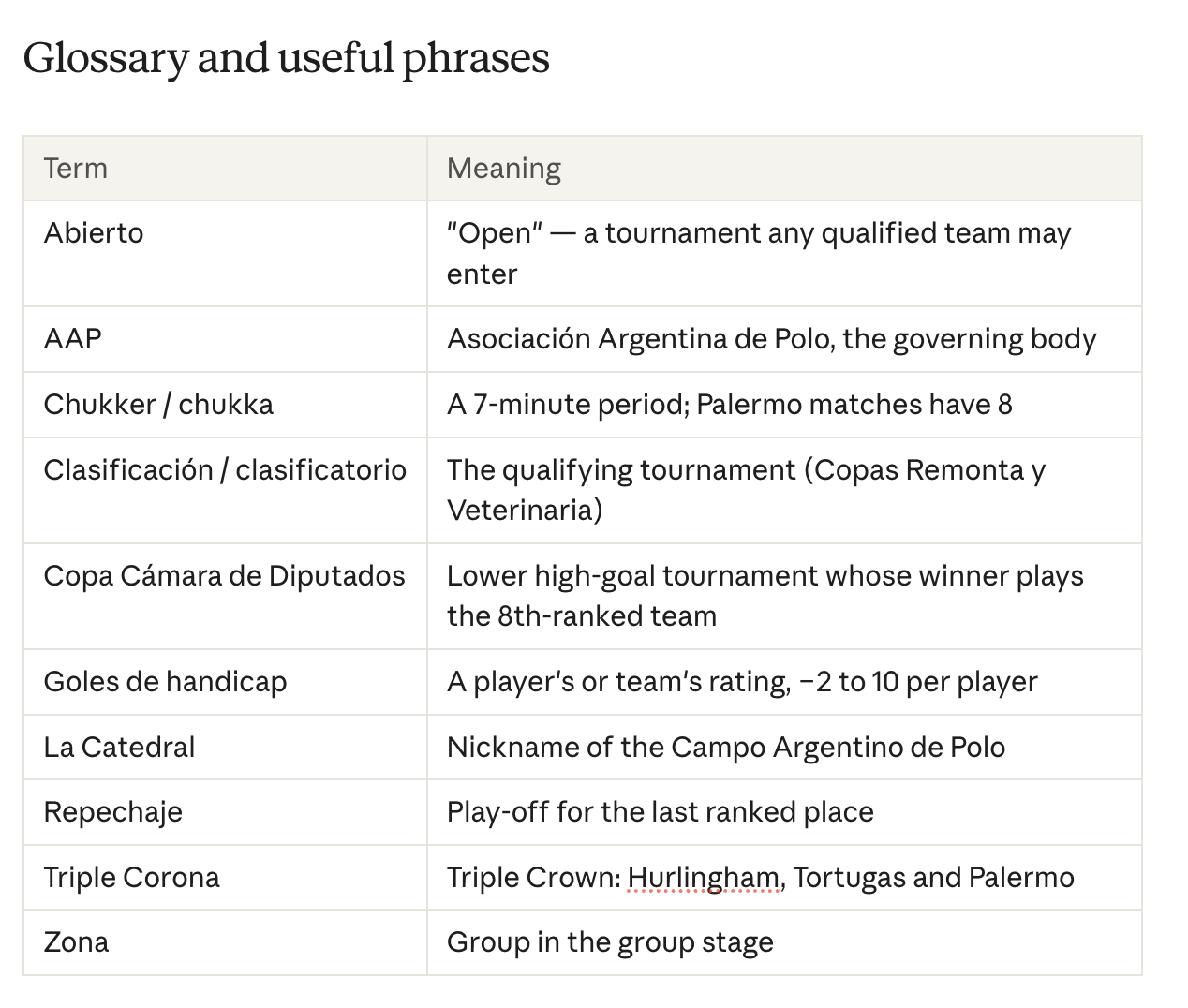
- Official name: Campeonato Argentino Abierto de Polo. Locals just say "Palermo" or "el Abierto".
- Age: played every year since 1893; it was called the River Plate Polo Championship until 1923.
- Venue: the Campo Argentino de Polo, nicknamed La Catedral ("the Cathedral"), on Avenida del Libertador in the Palermo district of the city.
- Organiser: the Asociación Argentina de Polo (AAP), Argentina's governing body.
- The Triple Crown: Palermo is the last of three big spring tournaments. Hurlingham (Sept–Oct) comes first, then Tortugas (Oct–Nov), then Palermo. Winning all three in one season is the sport's grand slam.
For scale: the US Open at Wellington and the UK's Gold Cup at Cowdray are top events, but they are played at 22 goals. Palermo is played at up to 40 goals — the highest level of polo that exists (explained below).
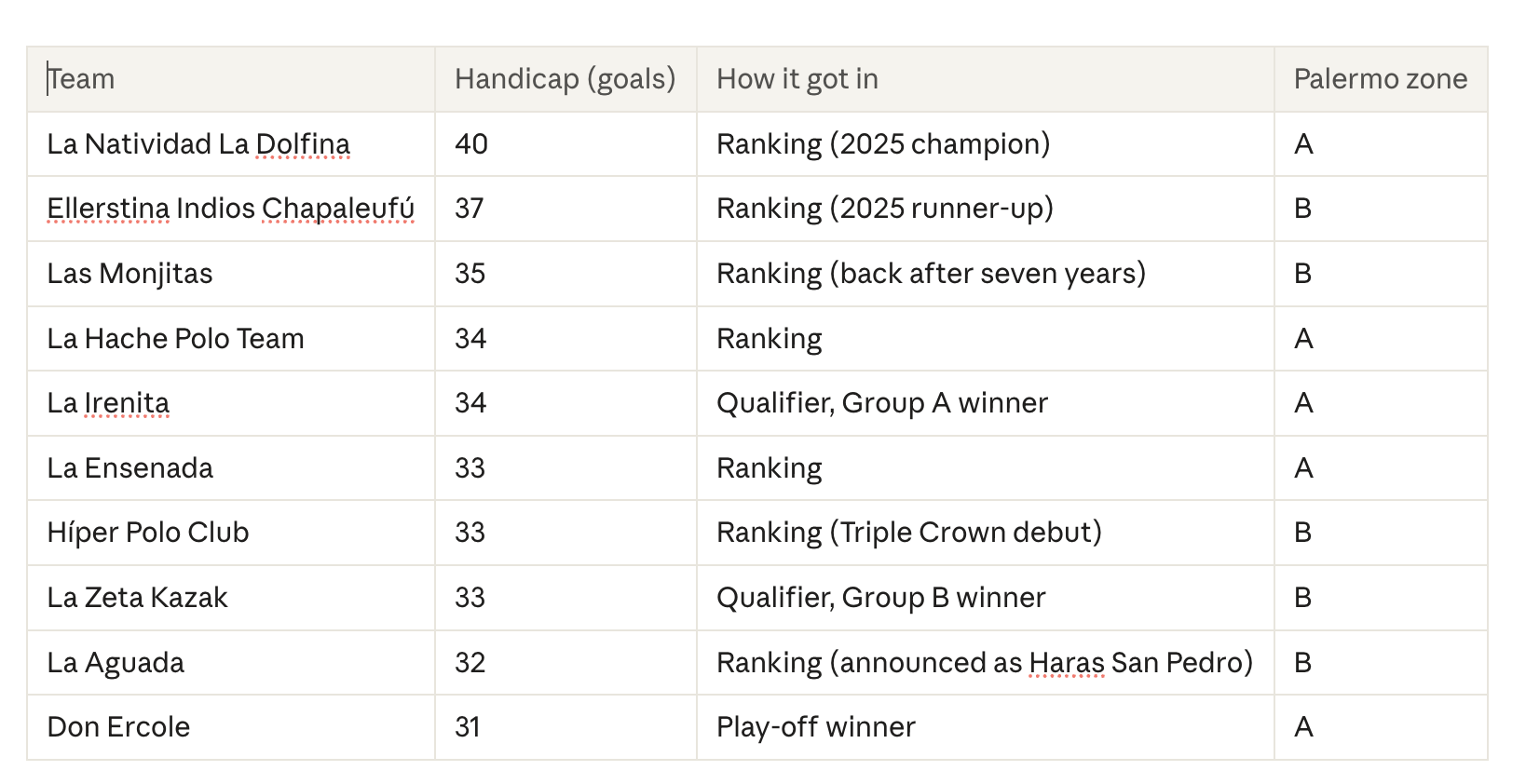
The defending champion is La Natividad La Dolfina, which beat Ellerstina Indios Chapaleufú 17–13 in the 2025 final. In 2026, it has already won the Hurlingham Open, beating La Hache in the final.
Plan your trip
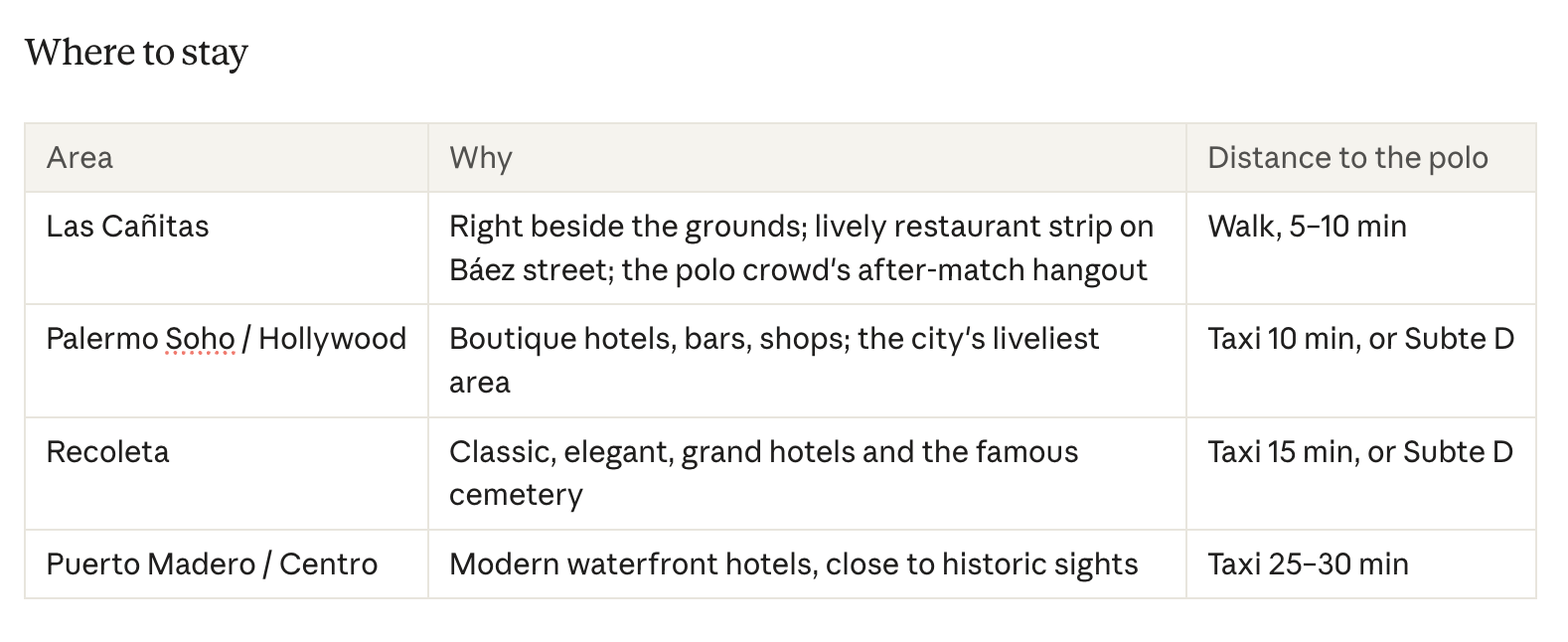
Book flights and a hotel near Palermo first; tickets for the polo can wait until the AAP announces prices. Late November to mid-December is high season in Buenos Aires, and rooms near the grounds go early for the final weekend.
Entry and paperwork
- No visa for US or UK passport holders staying up to 90 days as tourists, and no entry fee.
- Passport valid for at least six months from arrival.
- Travel health insurance has been an official entry requirement for all visitors since 2025; carry proof of cover for your whole stay.
- Time zone: UTC−3 all year, no daylight saving. In Nov–Dec that is 2 hours ahead of New York and 3 hours behind London.
Money
- Use a foreign credit card for most things. Cards issued abroad are charged at the favourable "MEP" exchange rate, close to the street rate, so you no longer need to carry wads of cash.
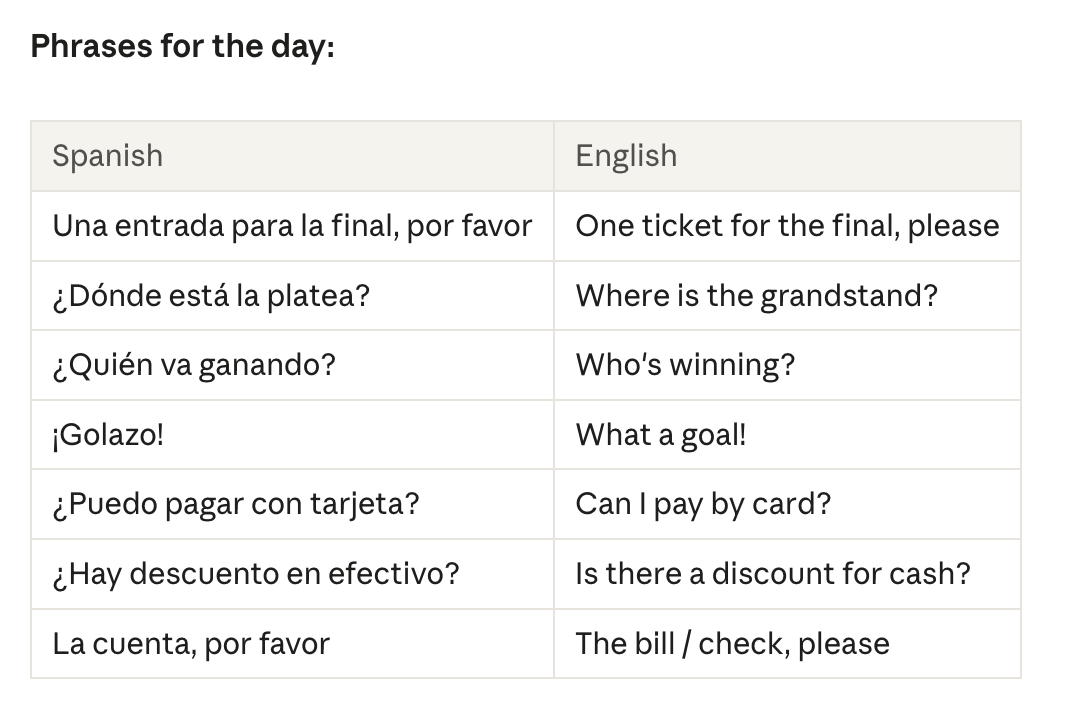
- Bring some US dollars in clean, undamaged notes to change for pesos: small cafés, kiosks and tips often need cash, and many restaurants give 10–15% off for cash — ask "¿hay descuento en efectivo?"
- Avoid ATMs where you can: withdrawal limits are low and fees high.
- Hotels: foreign visitors paying with a foreign card or transfer are not charged the 21% VAT on accommodation — check that your bill shows it.
- Prices are shown with a $ sign but mean pesos unless marked US$.
Getting around
- From the airport: international flights land at Ezeiza (EZE), about 45–60 minutes by car from Palermo. Use an official airport taxi desk or a ride app.
- Ride apps: Uber, Cabify and DiDi all work; black-and-yellow street taxis are fine too.
- Subte and buses: you need a rechargeable SUBE card, sold at kiosks and stations. Line D runs through Palermo to the polo.
Safety and practicalities
- Buenos Aires is generally safe for visitors. The main risk is phone and bag snatching — don't hold your phone at the kerb where motorbike thieves can grab it.
- Weather: late spring to early summer, typically warm to hot and sunny, with afternoon thunderstorms that can postpone matches.
- Language: Spanish (Argentine accent: "ll" and "y" sound like "sh"). English is widely spoken in hotels and among the polo crowd.
- Plugs: Type I (angled flat pins, as in Australia), 220V. Bring an adapter; check US devices handle 220V.
- Tipping: around 10% in restaurants; card tips are now allowed (Worldly Adventurer).
Matchday at Palermo
A day at Palermo is half sport, half social event: arrive early, walk the grounds, find your seat for the main match, and stay for drinks in Las Cañitas afterwards.
Pick your day
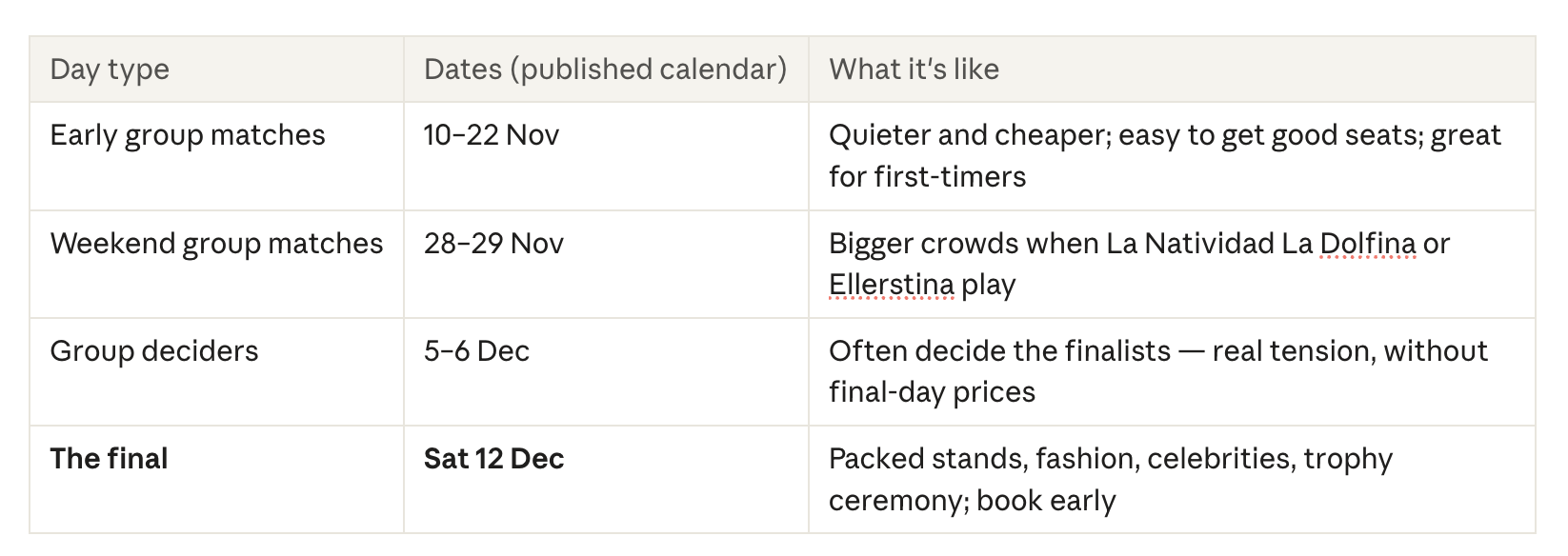
Check which teams play when: the big two draw the biggest crowds. The fixture after the first two matchdays is set according to results, and the AAP has said the opening dates will move because of the papal visit — confirm on aapolo.com before you book.
Tickets
- No more free days. Earlier editions let the public in free for the first few matchdays; from 2026 every match is paid. Prices vary by match and day and had not been set at the September launch.
- Where to buy: the official channels on aapolo.com/palermo. Tennium, the company behind tennis's Argentina Open, is the AAP's new commercial partner.
- Seats: the central grandstand blocks on Ground No. 1 give the best view; hospitality packages with lounges and catering are sold separately by agencies.
Getting to the grounds
- Address: Campo Argentino de Polo, Av. del Libertador and Dorrego, Palermo.
- Subte: Line D to Ministro Carranza or Palermo, both within walking distance. The Mitre train also stops nearby.
- By car: take an app ride and agree a pick-up point a few blocks away; traffic around Libertador is heavy after the final.
On the day
- Timings: in 2025 matches started at 14:00 and 16:30, with the main match on Ground No. 1. Arrive 45–60 minutes early to get through the gates and settle in.
- Divot stomping: at half-time (after the 4th chukka) spectators walk onto the field to tread in the divots. Join in — it's the best photo of the day.
- Food and drink: the grounds have bars and food stands, and sponsors run champagne and wine lounges; there are plenty of restaurants nearby in Las Cañitas for before or after.
- Dress: smart casual. Linen, chinos, summer dresses and flat shoes (heels sink on grass). No one expects Royal Ascot formality, but the final is dressier.
- Bring: sunscreen, sunglasses, a hat, water, a light layer for the evening, and a card plus some pesos.
- Watching from home: in Argentina matches air on Disney+, and the AAP streams some games on its YouTube channel (AAP). Check what's available in the US and UK nearer the date.
- After the match: walk to Las Cañitas, where players, grooms and fans fill the bars on Báez street.
Polo in two minutes
Two teams of four riders try to hit a ball through the opponent's goalposts with long mallets. The rules are close to what you'd see in the US or UK, with a few Argentine habits.
- Field: about 300 yards long and 160 wide — about seven American football fields, or five rugby pitches.
- Chukkas: a game is split into periods of 7 minutes. At Palermo a match is 8 chukkas (UK and US high-goal games are usually 6). Argentines write it chukker.
- Ponies: players change horses every chukka, often mid-chukka too. A top player brings 10+ horses to a match; many are clones or bred by the player's own organisation.
- Positions: No. 1 (attacker), No. 2 (attacking midfield), No. 3 (playmaker, usually the best player), No. 4 or "back" (defender).
- Line of the ball: the key safety rule. The path a ball travels creates a right of way; crossing in front of a rider on that line is a foul.
- Penalties: fouls give free hits from set distances ("Penalty 1" is an automatic goal, "Penalty 2" is a 30-yard shot, and so on).
- Ends switch after every goal, to even out wind and ground.
- Ties go to extra chukkas: first goal wins ("golden goal").
For spectators: the scoreboard shows goals per chukka. At half-time (after the 4th chukka) the crowd walks on the field to "stomp the divots" — the tradition you may know from Pretty Woman.
Who to watch in 2026
La Natividad La Dolfina is the clear favourite; the story of the season is whether Adolfo Cambiaso can draw level with the all-time record. He has 19 Palermo titles, one behind Juan Carlos Harriott's 20.
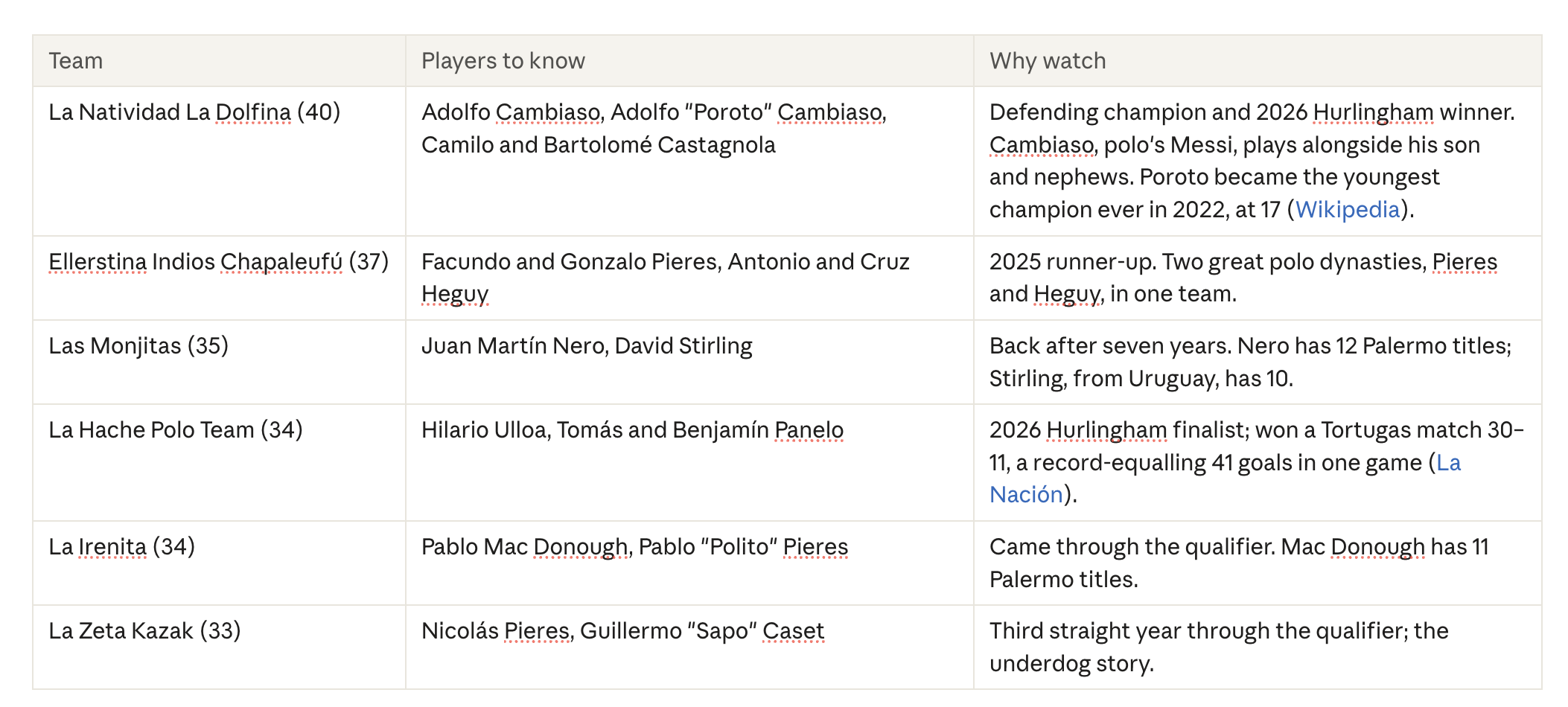
The other four — La Ensenada, Híper Polo Club, La Aguada and Don Ercole — rate 31–33 goals and are mostly fighting for ranking points, which decide whether they keep their place in 2027.
The 2026 format: two groups of five, then a final
The ten teams split into two zones of five, each team plays the other four once, and the two zone winners meet in the final on Saturday 12 December. There are no semi-finals: one loss in the group can end a team's hopes.
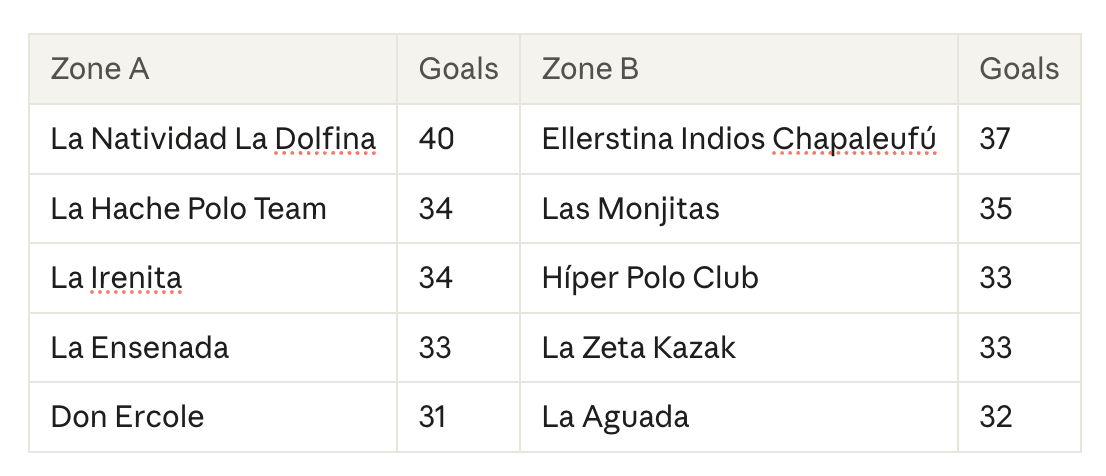
- Published calendar: matchdays 1–2 on Tue 10 and Wed 11 Nov; 3–4 on 14–15 Nov; 5–6 on 21–22 Nov; 7–8 on 28–29 Nov; 9–10 on 5–6 Dec; final Sat 12 Dec.
- Watch for a date change. Pope Leo XIV visits Argentina 8–11 November, with a mass in Palermo. The AAP said the opening dates would move because of it; check the final fixture on aapolo.com.
- Tie-breaks: if two teams finish level on wins, their head-to-head result decides who goes through.
- Fixture order: after the first two matchdays, the schedule is set according to results, so the big group-deciding games land on the last weekends.
- Rain: matches are often postponed due to rain. The 2025 zone deciders slipped to midweek, and Tortugas 2026 lost almost a week.
Beyond Palermo: more polo, and the city
The best add-on to the Open is a "polo day" at an estancia outside the city, where you ride, take a lesson from a professional and eat an asado — no riding experience needed.
Play or watch more polo
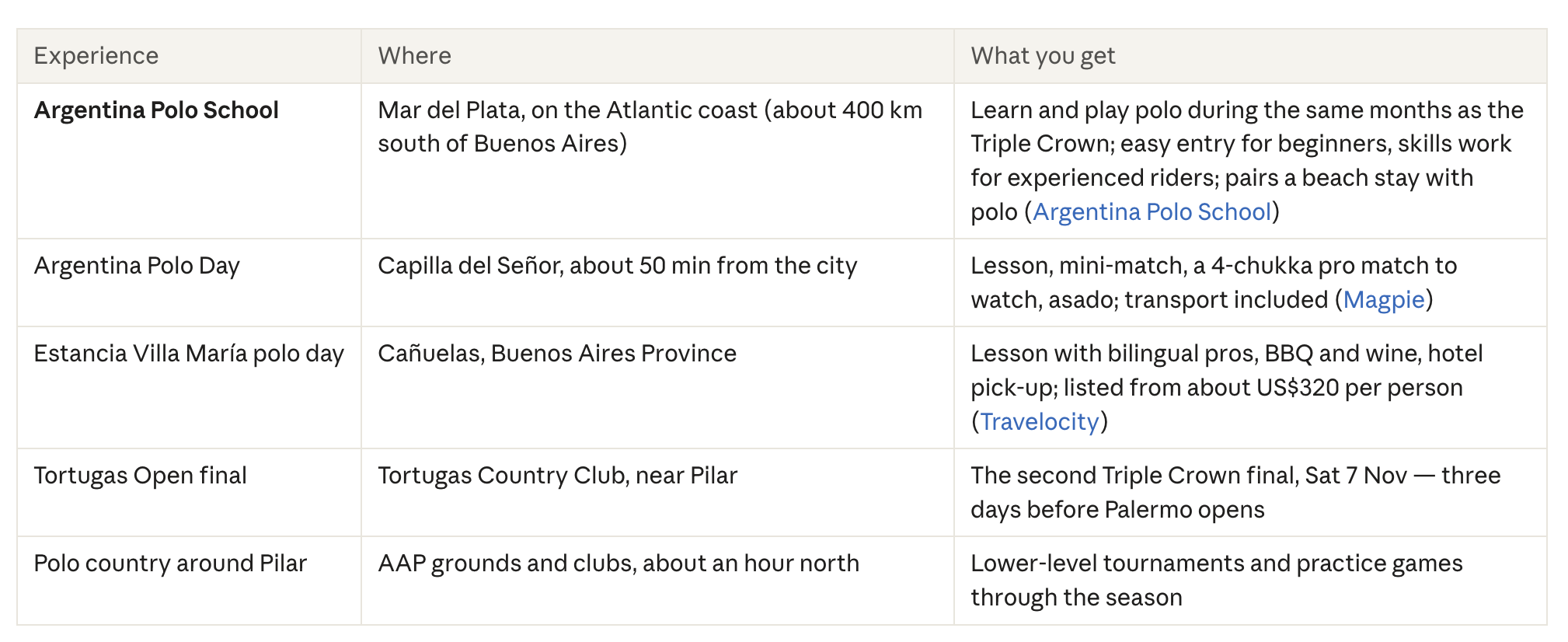
Book polo days through the operator or a major tour site, and check the price includes transfers, lunch and equipment.
Make a week of it
- Eat: a steak dinner at a parrilla, empanadas, and Malbec. Dinner starts late — 9 pm is normal.
- Tango: a dinner show for first-timers, or a milonga (local dance hall) to watch the real thing.
- Sights: Recoleta Cemetery (card payment only for foreigners), the Teatro Colón opera house, colourful La Boca, and San Telmo's Sunday antiques market.
- Day trips: the river delta at Tigre, or a ferry across the River Plate to Colonia del Sacramento in Uruguay (bring your passport).
- Timing: a trip of about a week in early December lets you catch the group deciders (5–6 Dec) and the final (12 Dec).
Handicaps: the "goals" that rate every player
Every player has a handicap from −2 to 10 "goals"; a team's handicap is the sum of its four players. Despite the name, it has nothing to do with goals scored — it is a skill rating, like a golf handicap turned upside down (higher is better).
- 10 goals is the maximum. Only a dozen or so players in the world hold it, nearly all Argentine.
- Team handicap = the four ratings added up. Four 10-goal players make a perfect 40-goal team.
- Palermo entry band: teams must be between 28 and 40 goals. In practice, the 2026 field runs from 31 to 40.
- No head start at Palermo. In handicapped tournaments, the weaker team starts with goals on the board. The Argentine Open is played "open" — no handicap goals are awarded, so a 31-goal team faces a 40-goal team at 0–0.
- Who sets them: in Argentina, the AAP reviews handicaps after each season. US players are rated by the USPA, UK players by the HPA, and ratings often differ between countries for the same person.
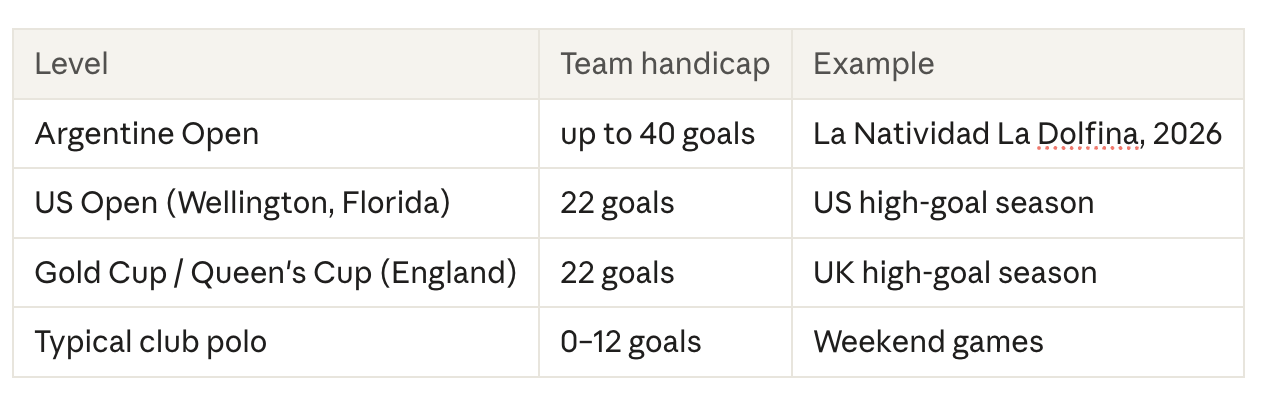
For 2026, La Natividad La Dolfina is the only 40-goal team: Camilo Castagnola, Adolfo Cambiaso, his son Adolfo "Poroto" Cambiaso and Bartolomé Castagnola, all rated 10.
How teams get in: the points ranking and the qualifier
Ten teams play Palermo: eight earn their place through a season-long points ranking, and two win it in a qualifying tournament a few weeks before. There is no invitation and no buying a spot — but because the points belong to players, a "team" can change its name and line-up from one year to the next.
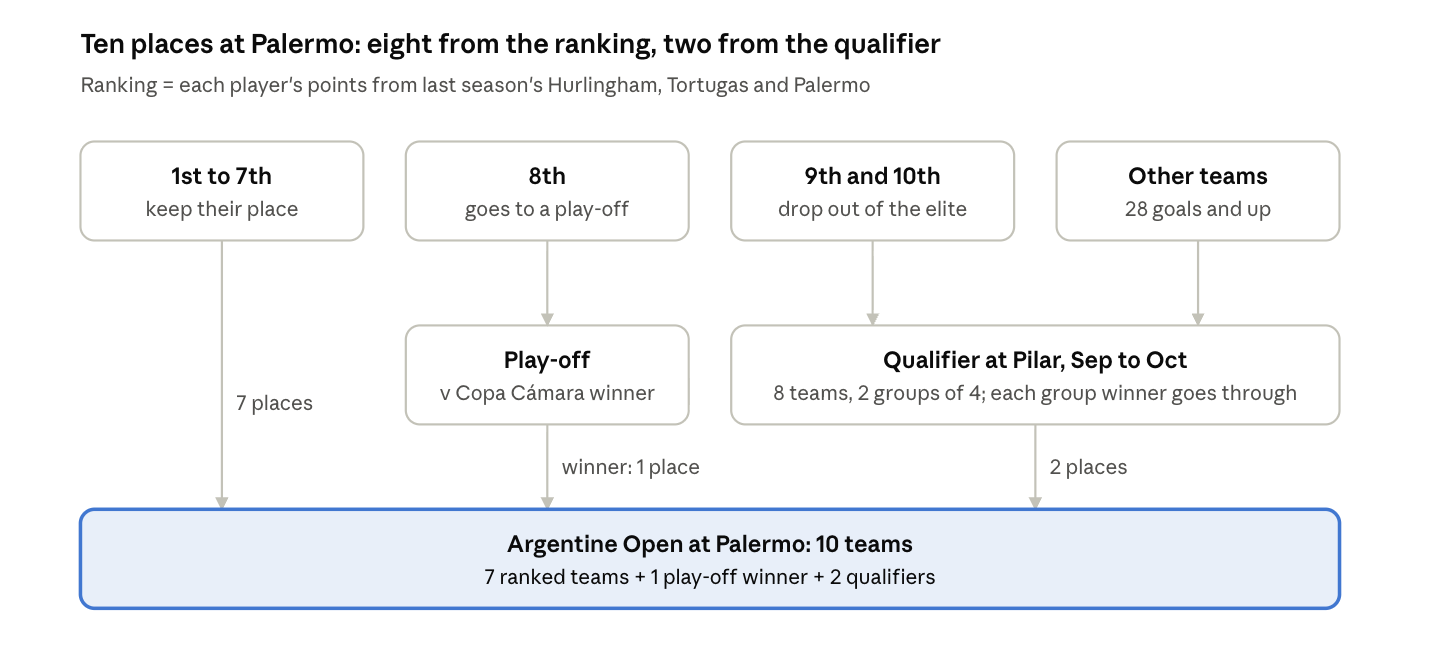
Real example: La Zeta Kazak lost the play-off after the 2025 season, then won its way back to Palermo through the 2026 qualifier.
Step 1 — The Triple Crown points race
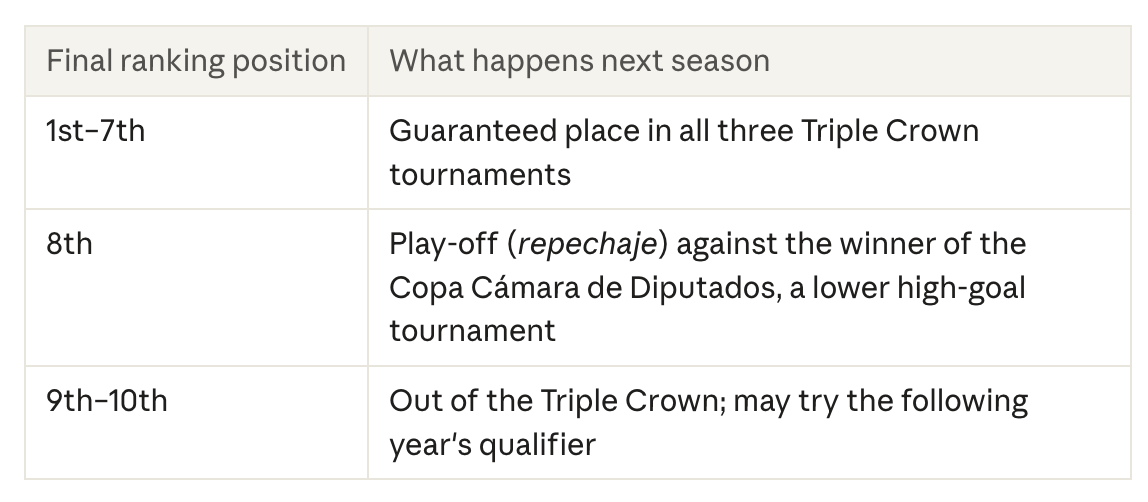
The ten teams in each year's Argentine Open — 40 players — play a points race across Hurlingham, Tortugas and Palermo. Wins earn ranking points, and where you finish decides who plays the following season
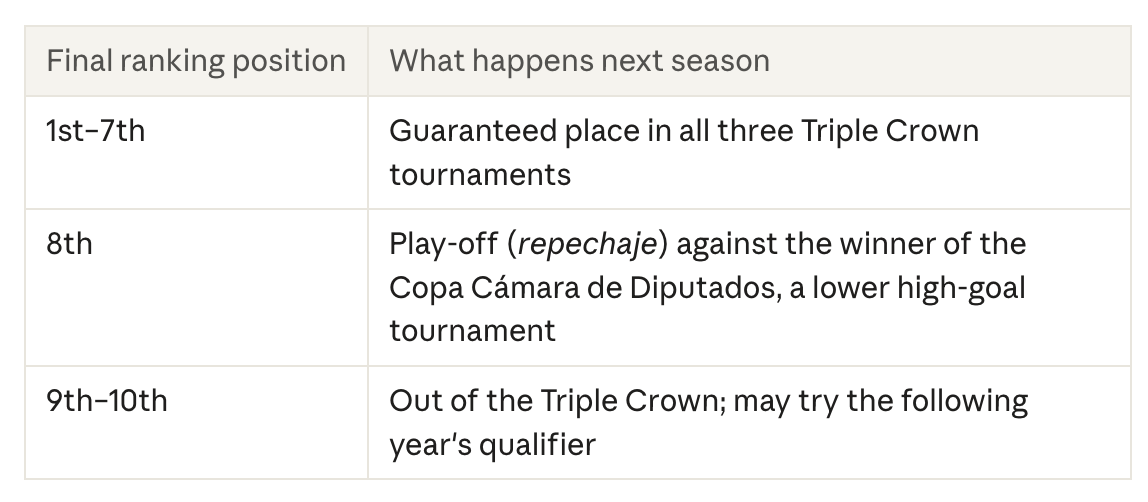
The twist: points belong to players, not teams. The AAP originally credited points to teams, but teams kept reshuffling players after the season. Now each player carries his own points, and a line-up's standing comes from its four players. That is why brand-new names can appear in the elite: they are built from players who already hold places.
Step 2 — The qualifier (Copas Remonta y Veterinaria)
Teams outside the eight play a short qualifier at the AAP grounds in Pilar, outside Buenos Aires. In 2026: eight teams of 28–34 goals, two groups of four, everyone plays everyone once, and each group winner goes through.
The 2026 example, step by step
- December 2025: the 2025 Open ends. La Natividad La Dolfina wins the title and tops the ranking. The two 2025 qualifiers, La Zeta Kazak and La Dolfina II, sit bottom of the ranking with 2,800 points each going into the last weekend, largely because they had played no earlier Triple Crown events in which to score.
- Play-off: La Aguada (now renamed Don Ercole), winner of the Copa Cámara de Diputados, beats La Zeta Kazak for the eighth spot.
- 21 April 2026: the AAP confirms the eight ranked teams and their line-ups, plus the eight qualifier teams.
- September 2026: the Palermo groups are drawn. The champion heads Zone A, the runner-up heads Zone B; the other six are paired by their players' 2025 ranking points and split by draw.
- 24 Sep – 2 Oct 2026: the qualifier. Both group deciders go down to the last chukka: La Irenita beats Velay 14–12 and La Zeta Kazak beats La Dolfina II 14–13.
- New for 2026: the two qualifiers also play Tortugas, not just Palermo. That answers the 2025 complaint that qualifiers started Palermo with zero points. The season grows from 44 to 52 matches.
- Dec 2026: the final ranking after Palermo will decide the 2027 line-up. The AAP had said it would change the method; whether the 7 / play-off / 2-out split stays for 2027 has not been published in the sources checked.
The 2026 field